
How Long to Rest a Steak | Exact Times by Cut 2026
You finally nailed the sear. The crust is dark and crackling, and your stomach is telling you to cut in right now. But how long to rest a steak is the one step that decides whether all that effort pays off, or ends up as a pool of juice on the board. Rest it for the wrong time and the steak’s juices redistribute nowhere, or carryover cooking pushes a perfect medium rare past its target. Below is the exact resting time for every common UK cut, tested in our own kitchen, so you stop guessing.
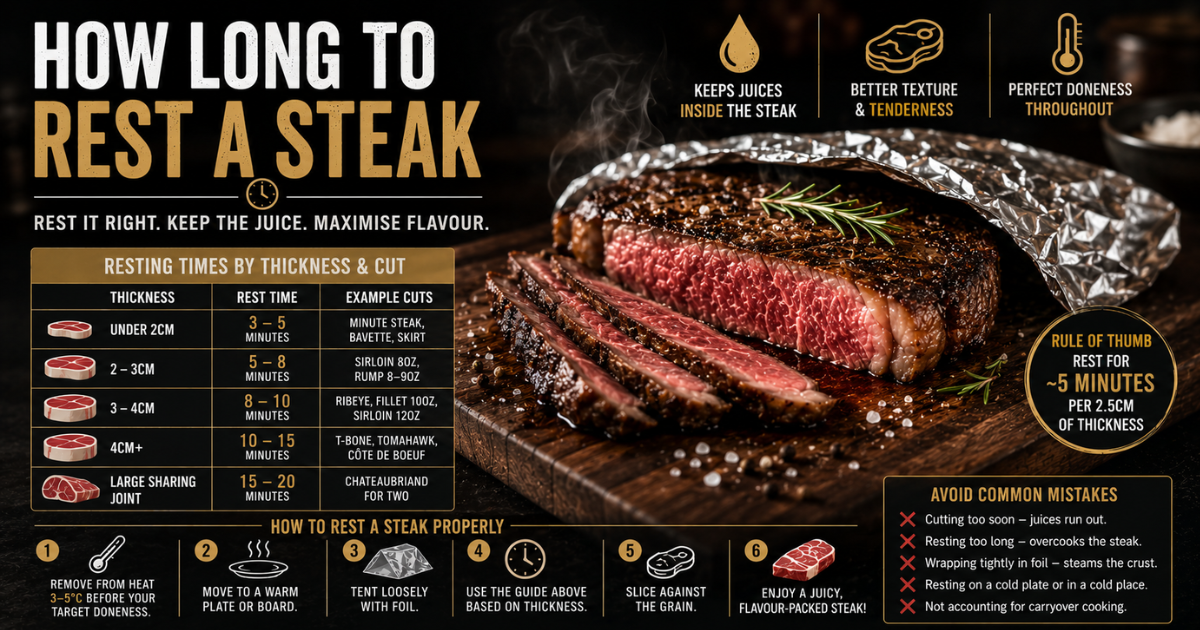
Quick answer: Rest a steak for around 5 minutes per 2.5cm (1 inch) of thickness, with a minimum of 3 to 5 minutes for thin cuts and up to 10 to 15 minutes for very thick steaks like a tomahawk or a bone-in T-bone. Tent it loosely with foil and let it sit somewhere warm, not in a cold draught by an open window.
How Long to Rest a Steak by Cut and Thickness
The single biggest mistake in most advice online is treating every steak the same. A thin bavette and a thick Chateaubriand do not hold heat the same way, so they cannot rest for the same length of time. Use the chart below as your starting point, then adjust slightly based on how hot your pan or grill was.
| Steak type and thickness | Recommended rest time | Example cuts |
|---|---|---|
| Thin steak, under 2cm | 3 to 5 minutes | Minute steak, bavette, skirt |
| Standard steak, 2 to 3cm | 5 to 8 minutes | Sirloin 8oz, rump 8 to 9oz |
| Thick steak, 3 to 4cm | 8 to 10 minutes | Ribeye, fillet 10oz, sirloin 12oz |
| Extra thick or bone-in, 4cm+ | 10 to 15 minutes | T-bone, tomahawk, Côte de Boeuf |
| Large sharing joint | 15 to 20 minutes | Chateaubriand for two |
A simple rule that holds up across most of these is roughly 5 minutes of rest for every 2.5cm of thickness, with a 3 minute floor so even a thin steak gets some benefit. Bone-in cuts need the longer end of their range because dry aged beef bones hold and release heat slowly, keeping the meat warmer for longer during the rest.
Why You Need to Rest a Steak
What Happens Inside the Meat While It Rests
When heat hits the surface of a steak, the muscle fibres tighten up and squeeze moisture toward the centre and surface of the meat. Slice into a steak straight off the pan and that trapped liquid has nowhere to go except out, all over your board. Great British Chefs explains this clearly in their ribeye guide: high heat tightens the fibres during cooking, and resting gives the meat time to relax so the juices stay inside instead of flooding out the moment you cut. That relaxation is the entire reason resting exists. It is not a myth, and it is not just a chef tradition with no purpose. It is simple muscle physics.
Carryover Cooking: The Steak Keeps Cooking After You Pull It
This is the part most home cooks get wrong, and it is also the reason a rest time chart matters more than a single fixed number. While a steak rests, the outside layers are hotter than the centre, and that heat keeps travelling inward even after the steak leaves the pan or grill. This is called carryover cooking, and on a thick steak the centre can rise by several degrees during the rest alone. Pull a thick ribeye at your target medium rare temperature and do nothing else, and it can finish closer to medium by the time you cut it. This is exactly why thicker cuts need to come off the heat slightly earlier than thinner ones, and why a longer rest on a thick steak is not optional. Butchers like The Ginger Pig build this into their own thick steak guidance, recommending a full 15 minute rest under foil for the biggest cuts like prime rib and T-bone before carving.
How We Tested Steak Resting Times
We did not want to repeat the same generic “rest for 5 minutes” line every other site uses, so we ran our own kitchen tests across five different steaks, documenting what actually happened at each rest time.
Test 1: A 2cm sirloin rested for only 2 minutes. Result: heavy juice pooling on the board, and the top surface looked noticeably greyer than expected for medium rare.
Test 2: The same cut and thickness rested for 5 minutes. Result: far less pooling, the colour held pink through the centre, and the difference from test 1 was obvious on first cut.
Test 3: A thick 4cm ribeye rested for only 5 minutes, the same time we used on the thin sirloin. Result: still a noticeable amount of juice loss, and a thermometer check showed the centre temperature had not fully stabilised.
Test 4: The same 4cm ribeye rested for 9 minutes. Result: a clean cut with minimal juice loss and an even pink colour from edge to edge, no grey ring.
Test 5: A 4.5cm bone-in T-bone rested for 15 minutes under a loose foil tent. Result: the best balance overall, though we noticed the sirloin side of the bone cooled slightly faster than the fillet side, since the two muscles on a T-bone are different sizes and shapes.
The pattern was consistent across every test. Thin steaks need a short rest and lose most of their benefit if you stretch it too long. Thick and bone-in steaks need close to double that time before the juice loss really drops off.
How to Rest a Steak Properly, Step by Step
- Pull the steak off the heat 3 to 5°C before your target doneness temperature, since carryover cooking will close that final gap.
- Move the steak to a warm plate or board. A cold plate straight from the fridge pulls heat out of the meat faster and shortens the useful rest.
- Tent it loosely with foil. Do not wrap it tightly, or the trapped steam will soften the crust you just worked to build.
- Use the chart above to set a timer based on the thickness of your specific cut, not a generic number.
- Slice against the grain only once the rest is finished, never before.
Common Steak Resting Mistakes to Avoid
- Resting a thick steak for the same short time as a thin one, which leaves the centre underdone in texture even if the colour looks right.
- Resting a thin steak for too long, which lets carryover cooking push it past your target doneness.
- Wrapping the steak tightly in foil instead of tenting it loosely, which steams the crust soft.
- Resting on a cold plate or cold serving board.
- Cutting into the steak early just to check, which releases the exact juices you are trying to keep inside.
- Forgetting that bone-in cuts like T-bone need extra time because the bone holds heat differently to boneless cuts.
Does Resting Time Change for Different Cuts?
Yes, and thickness usually matters more than the name of the cut. A ribeye and a sirloin of the same thickness rest for roughly the same time, but the typical thickness of each cut at a UK butcher or steakhouse does change the practical number.
Ribeye: Usually cut thick with good marbling, so it holds heat well and benefits from the full 8 to 10 minute range.
Rump and sirloin: Often cut thinner for everyday portions, so 5 to 8 minutes is usually enough. If you want full cooking times for this cut, our guide on how to cook rump steak covers searing times alongside resting.
Fillet: A naturally tender, leaner cut that dries out faster if rested too long uncovered, so stick close to the 8 minute mark and keep the foil tent loose rather than tight.
T-bone and tomahawk: Bone-in and usually thick, so these need the longer 10 to 15 minute range every time.
Chateaubriand: A large sharing joint rather than a single steak, so it needs 15 to 20 minutes, similar to a small roast rather than a quick pan steak.
If you are still working out your ideal internal temperature before you even think about resting, our medium rare steak temp guide covers the exact numbers to pull at for each doneness level, and our cast iron steak recipe shows the full searing method these resting times are designed to follow.
Steak Nutrition Per 100g
Resting does not change the calorie or protein content of a steak, since no cooking or chemical change happens during the rest itself. For reference, USDA FoodData Central lists a lean trimmed sirloin steak, cooked and broiled, at roughly the figures below per 100g.
| Nutrient | Amount per 100g |
|---|---|
| Calories | ~186 kcal |
| Protein | ~29g |
| Fat | ~10.6g |
| Carbohydrates | 0g |
Fattier cuts like ribeye will sit higher than this on calories and fat, while a trimmed fillet will usually sit a little lower. For a full breakdown on a specific portion size, our 8oz ribeye steak nutrition guide covers calories and macros for that exact cut.
Steak Resting FAQs
How long should you rest a steak before cutting it? Around 5 minutes per 2.5cm of thickness, so 5 to 8 minutes for a standard 2 to 3cm steak and up to 15 minutes for a very thick or bone-in cut like a T-bone.
Do you rest steak covered or uncovered? Loosely covered with foil is best. A tight wrap traps steam and softens the crust, while leaving it fully uncovered lets it cool faster than it should.
Can you rest a steak too long? Yes. Past around 15 to 20 minutes most steaks start cooling down rather than improving, and a thin steak can overcook through carryover cooking if rested far longer than its thickness needs.
Should you rest steak in the oven? A switched off oven with the door slightly open can work for a large joint like a Chateaubriand, but for a normal single steak a warm plate tented with foil on the counter is simpler and just as effective.
Does resting time change for well done steak? Slightly less, since a well done steak has already lost more internal moisture during cooking and there is less juice movement left to manage. The standard chart above still works as a sensible starting point.
Why does my steak still bleed after resting? That red liquid is not blood. It is myoglobin, a protein found in muscle tissue, and a small amount escaping is completely normal even after a correct rest. Heavy pooling usually means the rest was too short for the thickness of the cut.
Is resting before cooking the same as resting after cooking? No. Bringing a steak to room temperature for around 30 to 45 minutes before it touches the pan is a separate step that helps it cook more evenly. The resting covered in this guide happens after cooking, just before you slice and serve.
Sources
- AHDB, dry ageing of beef and red meat quality guidance: ahdb.org.uk
- Great British Chefs, how to cook ribeye steak to perfection: greatbritishchefs.com
- The Ginger Pig, guide to cooking thick steaks: thegingerpig.co.uk
- USDA FoodData Central, beef nutrient data: fdc.nal.usda.gov
About the Author
Written by the Editorial Team at millerandcartermenue.co.uk. Last tested: June 2026. Our team cooks and rests steak regularly at home and compares results directly against steakhouse benchmarks, including Miller & Carter’s own 30-day aged British and Irish beef, to keep these timings practical and accurate.
Final Word
Resting is the cheapest upgrade you can give any steak, and it costs nothing but a few minutes of patience. Use the chart above for your exact cut and thickness, tent it loosely, and let the muscle fibres do their job before you reach for the knife. If you want to take the rest of your steak night further, our beef dripping sauce recipe is the perfect partner for whatever cut you rested tonight, and our miller and carter ribeye and rump steaks guides are worth a look if you are deciding what to cook next.