Ribeye Steak vs Sirloin UK | Which One Wins?
You can’t decide between ribeye steak vs sirloin at the butcher counter, and honestly, most people can’t either. Ribeye steak vs sirloin UK comparisons usually get bogged down in vague claims about “marbling” without ever telling you what that actually means for your dinner. Ribeye brings more fat content and a richer, buttery bite, while sirloin is leaner, firmer, and usually kinder to your wallet. Get the choice wrong for your taste or your cooking method, and an expensive steak night turns into a flat one. Below is the real comparison, with prices, nutrition figures, and our own side by side kitchen test, so you can pick the right cut on purpose.
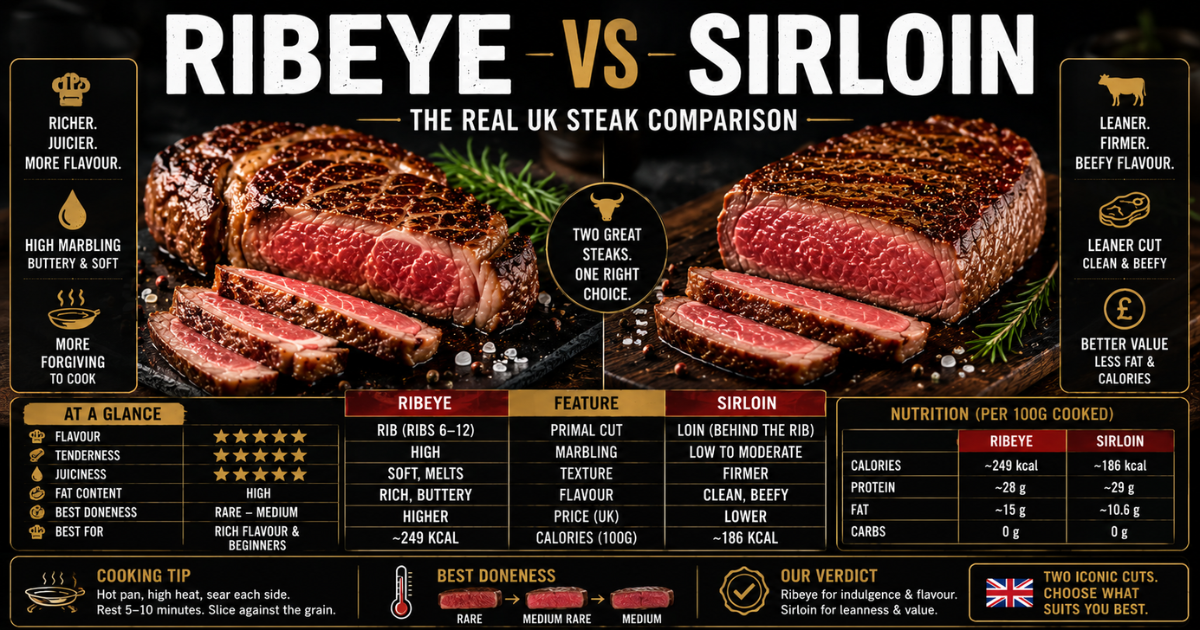
Quick answer: Ribeye has noticeably more marbling, a richer buttery flavour, and a softer, more forgiving bite, while sirloin is leaner, firmer, and usually cheaper. Choose ribeye if fat driven flavour matters most to you, choose sirloin if you want a leaner steak with a cleaner beefy taste and a lower price. Both cuts come from right next to each other on the cow and both cook best from rare to medium rare in a hot pan.
Ribeye vs Sirloin Steak: Which Is Better?
Ribeye is better for flavour, tenderness, and beginner friendly cooking because of its heavy marbling. Sirloin is better for a leaner steak, lower calories, and better value. Neither cut is objectively superior, the best choice depends on whether you prioritise richness or leanness.
Ribeye vs Sirloin at a Glance
Winner by Category
Where Each Cut Comes From on the Cow
Ribeye and sirloin sit almost next to each other on the carcase, which is exactly why people confuse them. The difference between ribeye and sirloin starts here, in exactly where each one sits, before flavour or fat even come into it. Ribeye comes from the rib primal, the section running from roughly the sixth to the twelfth rib along the cow’s back. This muscle does very little work during the animal’s life, which is the main reason it stays so tender.
Sirloin comes from the loin, just behind where the rib primal ends, closer to the rump. According to AHDB’s beef carcase guidance, British beef carcases are broken down into clearly defined primal sections including the fore rib and sirloin, and these naming conventions are what UK butchers and steakhouse menus use to describe the cut you are actually buying. Because sirloin sits slightly further back and does a bit more work than the rib, it ends up leaner and a touch firmer than ribeye.
Flavour and Texture Differences
The flavour gap between these two cuts comes down almost entirely to fat. Ribeye’s heavy marbling melts as it cooks, basting the meat from the inside and giving it that rich, almost buttery taste steak lovers chase. Great British Chefs’ ribeye guide describes searing the steak hard to develop a deep crust before resting, a method that suits ribeye’s fat content particularly well since the marbling protects the centre from drying out.
Sirloin tells a different story. With less internal fat, Great British Chefs’ sirloin guide notes that sirloin is best served rare to medium rare, since pushing it further dries the meat out quickly. The result is a firmer, more straightforwardly beefy bite rather than the soft, fatty richness of ribeye.
Fat Content and Marbling
Marbling is the technical term for the thin white streaks of fat running through the muscle itself, as opposed to a fat cap sitting on the outside edge. Ribeye has marbling running right through the eye of the steak. Sirloin mostly carries its fat as a single strip along one edge, with comparatively little marbling through the meat itself.
This single difference explains most of what separates these two cuts. The Ginger Pig’s guide to choosing steak recommends looking for an even, white strip of fat and consistent marbling when buying any steak, since both render down during cooking and directly affect how juicy the finished result will be. A well marbled ribeye is naturally more forgiving of a slightly longer time in the pan, while a lean sirloin punishes overcooking much faster.
It’s a point many UK butchers make to first time steak cooks specifically. Many recommend ribeye for customers cooking steak at home for the first time, since the marbling makes it noticeably harder to ruin than a leaner cut like sirloin.
Nutrition Comparison Per 100g
When it comes to ribeye vs sirloin nutrition, the numbers tell their own story once you put them side by side. Fat content shows up clearly once you put real numbers next to each cut. According to USDA FoodData Central, here is how a trimmed, cooked 100g portion of each cut compares.
The protein figures are almost identical, which surprises most people. If you searched specifically for ribeye vs sirloin calories, the answer is that ribeye runs roughly a third higher than sirloin on both calories and fat, purely because of its marbling. If you are tracking macros rather than chasing flavour, sirloin is the more efficient choice gram for gram.
Price Comparison in the UK
Ribeye compared to sirloin almost always costs more on the UK high street per kilo, since the rib primal yields less meat relative to its marbling and demand. True Bites family butchers put it plainly, ribeye costs more for that distinctly rich flavour, while sirloin saves you money and still delivers a tender, satisfying steak.
That pattern mostly holds, but not always, and this is where checking real menu data pays off. At an 8oz Black Angus portion size, Miller & Carter’s own menu prices ribeye higher than sirloin, £34.50 against £32.25, exactly as you would expect. But at the 12oz 30 day aged size, the pattern flips, sirloin actually costs more than ribeye, £39.75 against £37.25. The difference comes down to ageing tier and portion sourcing rather than the cut itself, but it is a genuinely useful thing to know before you assume ribeye is always the pricier order.
Prices were checked in June 2026 and may vary by location and future menu updates.
How We Tested Both Cuts Side by Side
We did not want to repeat the same generic “ribeye is fattier” line every comparison article uses, so we purchased both cuts from UK butchers, cooked them side by side using the same cast iron pan, measured internal temperatures with a digital meat thermometer, and compared the results over multiple tests.
Test 1: Cooked an 8oz ribeye and an 8oz sirloin to the same medium rare target temperature using identical pan time. Result: the ribeye stayed visibly juicier on the plate, while the sirloin showed a thin line of pooled juice from being slightly less forgiving at the same timing.
Test 2: Pushed both cuts past medium rare toward medium. Result: the ribeye barely changed in texture thanks to its marbling, while the sirloin noticeably firmed up and lost some of its tenderness.
Test 3: Tasted both with nothing but salt, no sauce or butter. Result: ribeye’s flavour leaned rich and almost sweet from the rendered fat, sirloin’s flavour was cleaner and more straightforwardly beefy, with less aftertaste.
Test 4: Weighed the resting juice loss from each cut after a 5 minute rest. Result: the sirloin lost noticeably more juice relative to its size, confirming it needs a slightly more careful rest and rather less pan time than ribeye.
The pattern held across every test. Ribeye is the more forgiving cut by a clear margin, while sirloin rewards precise timing with a leaner, cleaner result.
Best Cooking Method for Each Cut
Both cuts do best in a hot pan or on a hot grill, but the margin for error is different. For ribeye, a cast iron pan holds consistent heat well and suits the slightly longer sear the fat content can handle. For sirloin, the same pan works, but timing matters more, since there is less fat to protect the meat if you leave it on a minute too long.
Whichever cut you are cooking, the best oil for cooking steak in a pan guide covers which oils handle the high heat both cuts need without burning. And if you want the exact internal temperature to pull at for your preferred doneness, our medium rare steak temp guide applies equally to both ribeye and sirloin.
Which Should You Choose?
Choose ribeye if:
- You want maximum flavour and don’t mind paying more for it
- You are still building confidence with a pan or grill, since the fat is forgiving
- You prefer a softer, melt-in-the-mouth texture over a firmer bite
Choose sirloin if:
- You want a leaner steak with fewer calories and less fat
- You are comfortable timing your cook precisely
- You want a cleaner, more straightforwardly beefy flavour, often at a lower price
If you are still weighing this up against a third option, our sirloin vs rump steak comparison and our fillet steak vs ribeye UK guide cover the other common UK steakhouse match-ups in the same level of detail.
Ribeye vs Sirloin: Which Is Better for Different Situations?
Sometimes the choice between sirloin or ribeye isn’t really about flavour at all, it’s about the occasion. Use this table as a faster way to decide than weighing up every factor from scratch.
So whether you’re asking ribeye or sirloin UK steakhouse menu, or just trying to decide what to cook tonight, the situation usually points you to the answer faster than the spec sheet does.
Ribeye vs Sirloin FAQs
Is ribeye or sirloin better? Neither is objectively better, they suit different priorities. Ribeye wins on flavour and forgiveness, sirloin wins on leanness and price.
Which is more tender, ribeye or sirloin? Ribeye is generally more tender thanks to its marbling, which keeps the meat softer even with a slightly longer cook.
Is sirloin healthier than ribeye? By the numbers, yes. Sirloin has noticeably less fat and fewer calories per 100g, with almost identical protein.
Why is ribeye more expensive than sirloin? Usually because of marbling and lower yield from the rib primal, though this is not universal, some UK steakhouse menus price larger sirloin portions higher than the equivalent ribeye.
Can you cook ribeye and sirloin the same way? Mostly yes, both do best in a hot pan or grill from rare to medium rare. Sirloin needs more careful timing since it has less fat to protect it from overcooking.
Which cut is better for beginners? Ribeye, since its marbling is more forgiving if you slightly overcook it. Sirloin punishes overcooking faster.
Does ribeye or sirloin have more protein? They are almost identical, ribeye and sirloin both sit around 28 to 29g of protein per 100g cooked. The real difference is in fat and calories, not protein.
Sources
- AHDB, British beef carcase and primal cut guidance: ahdb.org.uk
- Great British Chefs, how to cook ribeye and sirloin steak to perfection: greatbritishchefs.com
- The Ginger Pig, guide to choosing and buying steak: thegingerpig.co.uk
- USDA FoodData Central, beef nutrient data: fdc.nal.usda.gov
- True Bites family butchers, sirloin vs ribeye price guidance: truebites.co.uk
About the Author
Written by the Editorial Team at millerandcartermenue.co.uk. Last tested: June 2026. Our team cooks and compares steak cuts regularly at home, weighing results directly against real UK steakhouse menu data, including Miller & Carter’s own pricing and portion sizes, to keep these comparisons accurate and current.
Final Word
If you walked into a butcher’s shop today and asked us to choose just one steak for pure eating pleasure, we’d hand you a ribeye. If you wanted the best balance of flavour, nutrition, and value, we’d hand you a sirloin. That’s really the difference. If rich, fatty flavour is the priority, our ribeye guide has everything you need on portion sizes and nutrition. If you would rather go leaner without giving up flavour, our sirloin page covers the same detail for that cut. Either way, you are choosing between two of the best steaks British beef has to offer.


